ST ISSELL’S CHURCH Saundersfoot
A HISTORY
By Rowland Williams.
The first mention of the church of St Issell’s is found in the Demetion Code, or laws, of Hywel
Dda in the 10th century where it is described as one of the seven bishop’s houses in Dyfed. The
term bishop’s houses suggests that the incumbent exercised a degree of episcopal authority in
the area. St Issell, in Welsh Usyllt, was a medieval saint of the Celtic Church in the 6th century
wholly associated with Pembrokeshire and reputed to be the father of St Teilo.
In the Taxatio Ecclesiastica 1291-92 of Pope Nicholas IV the church is described as the
benefice of Churchton alias St Issell’s with a value of £13.6.8d. By comparison Tenby is valued
at £16.13.4d, Begeli at £12.0.0d and St Florence at another £13.6.8d. Carew Cheriton had the
highest valuation in Pembrokeshire at £40.0.0d, no doubt reflecting the primacy of agriculture
in the late medieval economy.
The Valor Ecclesiasticus of 1535-36, Thomas Cromwell’s valuation of church property for the
Crown, misnames the church as vicaria Sancti Ismaelis with a valuation of 77s.6d and an
annual tithe of 7s.9d. The vicar, who is described as having a house there, is named as Henry
Stiffvowe (tenure1534-54) though he is named as Henry Starbow on the church’s honours
board. The last remains of Stiffvowe’s house or the medieval rectory were apparently removed
during the incumbency of the Rev. John Jones 1888-1912 when walling on the northern
boundary of the old churchyard was taken down.
Neither John Leland (Itinerary c.1538) nor Edward Lluyd (Parochialia c.1685) describe St Issell’s
and Samuel Lewis (Topographical Dictionary of Wales 1833) notes only its attractive location. In
the Religious Census of 1851 the attendance recorded by the vicar on census Sunday was 183
adults and 77 scholars, that the average attendance for the morning service was 200 adults and
70 scholars, for the afternoon service 200-300 adults and 80 scholars. The morning and
afternoon services were held on alternate Sundays and that there was a resident curate. For his
Church Notes Sir Stephen Glynne visited St Issell’s on 1 July 1867 but unfortunately his
description of the church postdated Kempson’s restoration of 1862-64.
The earliest recorded vicar of St Issell’s is John Lamb, appointed 1492, and succeeded by John
David in the same year. Henry Stiffvowe, or Storbow noted above, followed in 1534 and served
until 1554.
CHURCHYARD
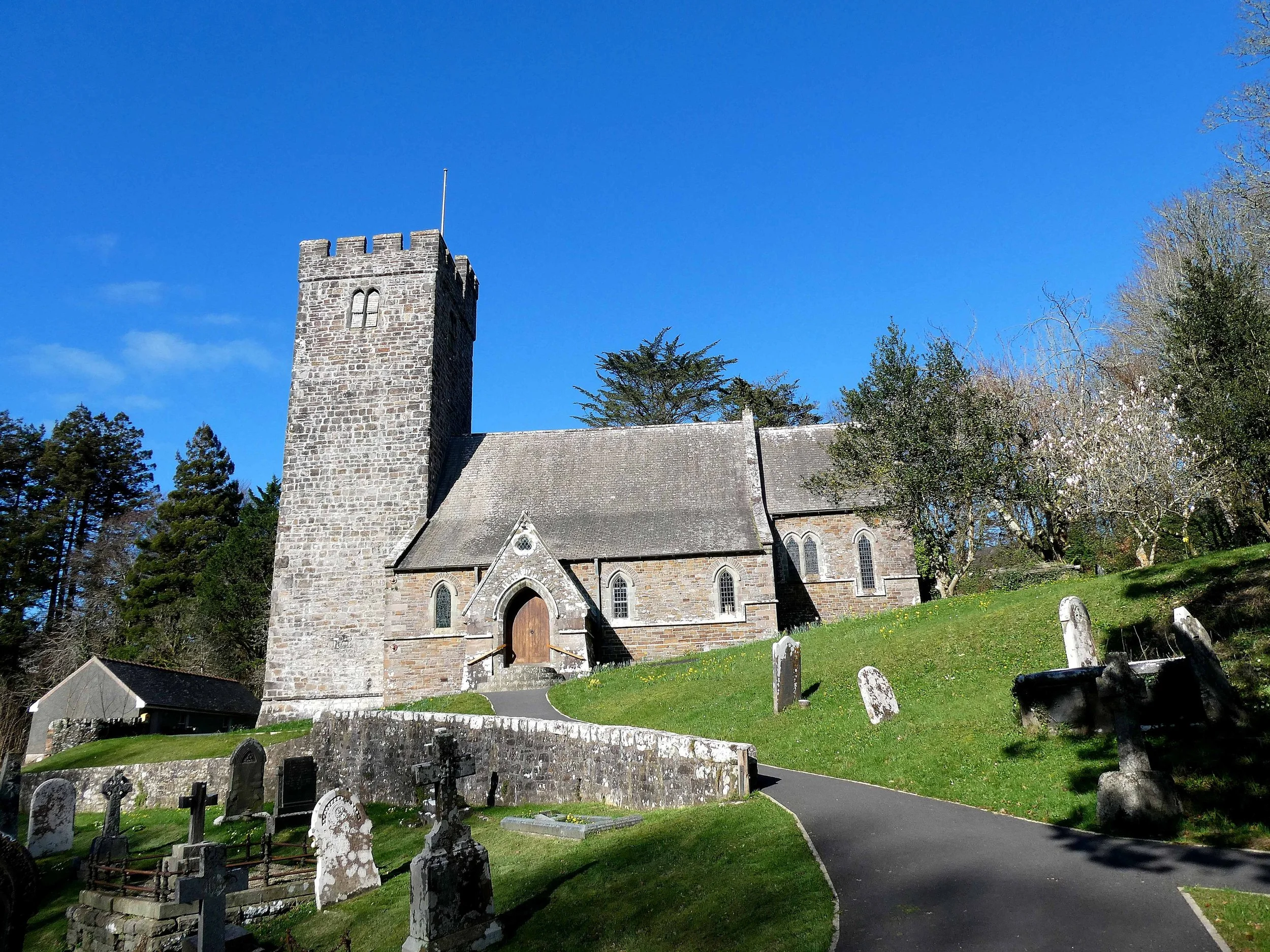
There is a partially restored medieval churchyard cross on the north side of the church, its four-
stepped base surmounted by a broken head.
The original churchyard adjoined the church on its north, south and west sides. Kelly’s
Directory of 1914 states that the cemetery was enlarged in 1856 with the purchase of two
adjacent meadows for the sum of £700, and a transcript of a memoir held by the Saundersfoot
and District Historical Society indicated that the churchyard was ‘closed,’ that is, enclosed
around 1857 when a stone wall was constructed between it and the nearby roads. The
enlargement of 1856 necessitated the re-alignment the roads by moving them to the west.
The three sets of perimeter cast iron churchyard gates, made at the Woodside Foundry of David
and Parcell at Wiseman’s Bridge, were probably installed at the time of the enlargement and
enclosure. The cast iron memorials in the churchyard date from the late 19th century.
The parish war memorial of 1921 is located on an island at the road junction immediately
beyond the churchyard, its design of a slender Celtic Cross is by A. Caroe who had completed
the church’s pulpit a year before.
Under the provisions of the Local Government Act 1894, which created civil parish
administrations, the south-west portion of the churchyard was transferred to the newly formed
St Issell’s Parish Council with the church retaining the north-east section. A new burial ground
has in recent years been developed on land opposite the churchyard.
The churchyard is crossed by a semi-culverted stream known locally as Friar’s Brook. While
there is no record of a Friary in the area it is possible that the medieval rectory, and the
designation of St Issell’s as one of the bishop’s houses in Dyfed, could have played such a role.
There is a former schoolroom within the churchyard to the west of the tower that once housed a
National, or church elementary, school. This provision was superseded by the formation of the
St Issell’s United District School Board in 1874 and its acquisition of the Saundersfoot British
School. The Report of the Commissioners into Charities 1819-37 noted that by his will of 1712
John Jones gave the parish £300, the interest from which was to be used to teach poor children
to read and write and that there should be equal numbers of girls and boys, an unusual
stipulation at that time. Jones’s school was closely associated with St Issell’s church, the
charity was superintended by the Bishop of St David’s and the investment by the Picton Castle
Estate, and by the 1830’s a house to accommodate the school had been built by public
subscription in the churchyard.
ARCHITECTURE
SUMMARY
In 1860 the vicar of St Issell’s, the Rev. James Dalton, announced that his church was in a
ruinous condition and that it was cavernous, low and unhealthy. There were sufficient funds
available by 1862 to employ the architect Frederick R. Kempson who worked largely for the
Anglican Church and held practices in Hereford and Llandaff. He decided not to demolish the
medieval church but rather to have it dismantled and to re-use as much of its features as
possible. The result was to create a sympathetic Victorian restoration with notable medieval
elements. Kempson also appears to have followed the original ground plan though some
external structures were lost: those between the south aisle and chancel, between the north
aisle and the tower and to the east of the chancel.
RESTORATION
With the exception of the tower the whole of the exterior was rebuilt using local sandstone in
snecked courses with lancet windows in the Early English style. The floor level of the nave and
aisles was raised by some six feet to create an airy void or ventilated undercroft. The work
began in 1862 and was completed by 1864, the church reopening on 30 August of that year.
TOWER
Externally the tower is the only remaining part of the medieval church. It is built in informally
coursed gritstone, plain and unbuttressed, with a crenellated parapet projecting slightly on a
string course. There are paired belfry openings on each face and in the west wall a group of
three square-headed lights under a square label mould. There is also a square mould above the
west door that is carried down to join the string course. Internally entry to the tower stairs is in
the northeast corner while in the southwest corner the remains of the vestry cupboard flooring
can be seen. There are three bells, one pre-Reformation, and the other two, by G. Davies of
Bridgewater, are dated 1719 and 1787.
The tower once contained a full width tiered gallery, known locally as a belfry, some of the
supporting corbels of which can be seen in the north wall. Access to the gallery was from a
staircase at the west end of the nave. The gallery was probably installed during the restoration
of 1862-64 when additional seating was created. It was removed c.1960.
INTERIOR
The parts remaining from the medieval church are the tower, north arcade, the chancel arch,
parts of the piers in the south arcade and the font. The arcade piers are octagonal with plain
caps and pointed arches. The single arch which continues the north arcade in the chancel is a
depressed pointed arch.
The chancel is short and is raised by three steps at the arch and one further step to the
sanctuary, though note the structure to the east of the chancel removed during the restoration.
The east bay of the north aisle opposite the chancel is also at a raised level. This bay has been
extended north to contain the organ and vestry added in 1911 by EV Collier. From the tower
base there is a flight of nine steps leading up to the nave, the tower floor probably indicative of
the medieval church floor; the tower gallery is noted above. The high altar, altar rail and reredos,
and the altars of each aisle, are by RL Boulton of Cheltenham 1960-61. The three lancets of the
east window have a common rear arch and wide reveals.
The late Norman font is a square bowl of oolitic limestone with a similar but slightly varied
design incised on all faces, with raised scroll features, irregularly symmetrical. There are
haphazardly placed stars and crescents, possibly a syncretic element. The limestone pilar is
probably two reused 12th or 13th century column caps, each with a primitive carved tete coupe
face on one corner.
After the Great War a new pulpit by Caroe was constructed as a memorial incorporating the roll
of honour. Carved in the Perpendicular style with St George and the dragon it includes a
tester or sounding board.
Throughout the church there is good stained glass of various dates from 1865 to 1925. The
oldest is the east window of the north aisle, to ER Stephenson 1865. A window in the south wall
of the chancel commemorates the Rev John Jones, vicar 1888-1912, and contains a
representation of the restored church held as a model in the hands of St Issell. The east
window, to Lady Anne Lewis, contains her portrait in a corner. The east window of the south
aisle or Lady Chapel is to CR Vickerman and his wife and sister-in-law, by Kempe and Tower
1912.
The church is listed as a well-detailed Victorian restoration of a medieval church retaining
significant early elements.